Phonemic Awareness
Phonemic awareness is defined as the ability to notice, think about, and work with the individual sounds in spoken words.
Assessment
In LCNA interventions, individual assessments reveal information about a child’s phonemic awareness, including
- upper and lower case letters the child can identify in some way.
- phonemes the child can hear in words.
- phonemes the child can connect to letters.
- specific phonemes the child can represent with letters in writing.
- the degree to which the child can locate words in a text after hearing them.
Examples of Instructional Procedures
- In writing, children learn to hear and record the sounds in words and notice the sequence of the sounds.
- Children work with letters and related sounds in a variety of ways (e.g., making personalized alphabet books to link sounds and letters).
- Children learn how to make words with magnetic letters by adding, deleting, and substituting phonemes.
- Reassembling a cut-up sentence requires children to think about sounds in words.
- As children orally read and reread texts, the teacher demonstrates ways to use phonemic awareness and letter-sound relationships to monitor reading accuracy and to solve new words.
Clay, M. M. (2005). Literacy lessons designed for individuals part two: Teaching procedures. Portsmouth, NH: Heinemann.
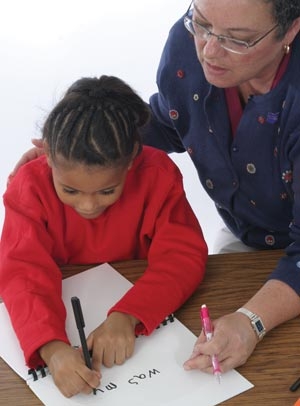
Writing in Reading Recovery includes procedures “designed to help a child to hear and think about the order of sounds in spoken words. This has to do with the ears hearing sounds and transmitting messages about those sounds to the brain. To write some new words in this writing segment of the lesson a child must analyze words into a sequence of sounds, must identify what sounds he can hear and must deal with the order or sequence in which the sounds occur.” — Clay, 2005, p. 70
