
Pausing Allows Us to Stop and Explore
by Tracee Farmer and Kathleen Brown
Watch a teacher and a student, and you will see a dance. An unchoreographed duet in which steps are decided in real time. It starts with observation, the teacher watching for hesitation or a sudden spark of understanding. Then comes a beat of silence. A deliberate pause, a moment of stillness where the teacher reflects, shifts their weight, and responds with a movement that invites the student forward. As the dance continues, the teacher assesses where they stand as the movement begins all over again. Teaching isn’t a rigid routine; it’s a continuous loop of movement and response grounded in careful observation.
According to Clay (2019), observation:
allows us to watch the child as he works, to see at least part of the focus of his attention, to watch him search for information in print and for confirmation of what he thinks. It enables us to observe him solve a problem, and sometimes express his delight when he discovers something new. (p. 3)
Whether in the classroom, in a small-group intervention, or in individualized tutoring, teachers need to use their observational skills to notice the actions a child takes and then infer what those actions may have meant. Observations help teachers determine what a child knows and how they know it. It’s also important to notice when a child knows something. For instance, a teacher might notice that a student initiates problem-solving in writing but not yet in reading. Noticing when helps us refine our teaching in the moment and plan for the next day.
Pausing occurs after an observation. It allows the teacher to reflect not only on what happened and why, but also on whether intervention is necessary at this moment. Pausing also leaves space for a child to initiate problem-solving. It sends the message that students have the knowledge and autonomy to make a decision. It is in the pause that we can respond with intention instead of a knee-jerk or routinized action. Pausing supports teacher decision-making.
Pausing is part of a recursive rhythm of observing, assessing, pausing, and responding. It’s difficult to separate the rhythms within the cycle. Instead, this continuous loop is closely linked to student-teacher interactions. In a sense, this delicate dance between teacher and student is part of a complex educational ecosystem in which both depend on one another.
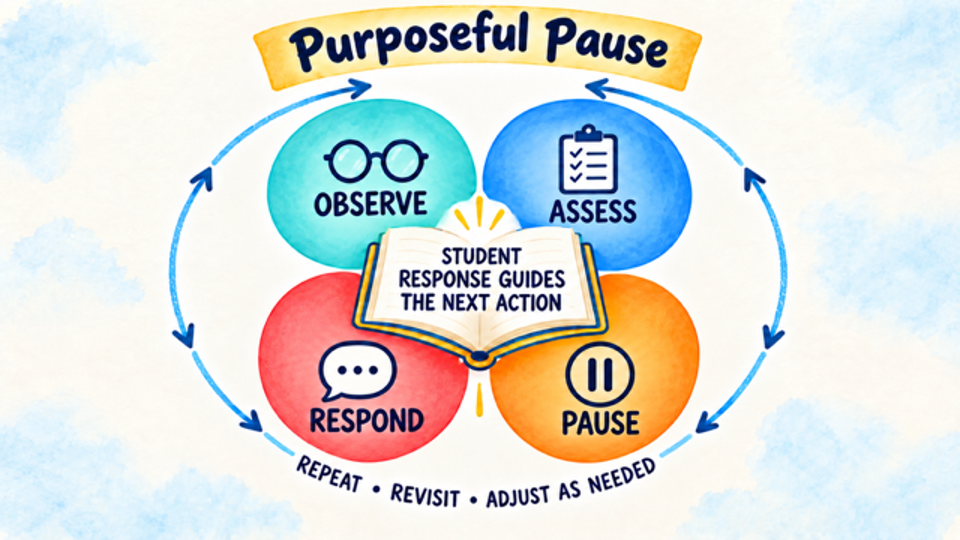
The scenarios below provide examples of the symbiotic relationship between student(s) and teacher. These interactions ebb and flow intentionally to guide teachers and learners toward meaningful solutions and support transfer across contexts. Although we have labeled individual parts of each interaction, the components within the cycle are deeply interconnected. At times, you will notice that after a pause, no response is indicated. That in itself is a response, as the teacher decided not to intervene. Ultimately, our goal with these scenarios is to illustrate a continuous cycle driven by intentional decision-making.
Scenario: As part of a district writing assessment, students in third grade are expected to respond to a prompt and write independently for 45 minutes. In preparation for the actual, timed writing assessment, the classroom teacher provided students with ample practice.
| Teacher | Part of Cycle |
| During one of the practice sessions, the classroom teacher observed that over half of the students had trouble getting started. He noted lots of frustration and wasted time. | Observe
Assess |
| Before jumping in to guide or instruct, the teacher took a moment to see what the students would do next. Some students started brainstorming ideas and then started to write. Others created a tree map to outline ideas before writing. | Pause |
| However, a handful of students just sat there, needing support. | Observe
Assess Pause |
| The teacher gathered those students and met with them in a quiet place in the back of the room. The teacher provided much-needed modeling and scaffolding. | Respond |
| Once the students were on their way and the writing was becoming easier, | Observe
Assess Pause |
| The teacher released each student back to their seats to finish the practice assessment. | Respond |
| The teacher observed that students were able to resume working independently. | Observe
Assess |
| He noted that in the coming days, a small group of students would need additional mini-lessons on organizing ideas before responding to a prompt. | Assess |
Scenario: A teacher is observing and listening to a child read Hermit Crab. When the student gets to the page that reads, “He likes to eat hermit crabs!” (p. 8), they read:
| Page | Text | Student | Teacher | Part of Cycle |
| 8 | He likes to eat hermit crabs! | He | Observe
Assess Pause |
|
| He looks at | Observe
Assess Pause |
|||
| He looks to…wait* | Observe
Assess Pause |
|||
| Points at He likes with a pencil. | Respond | |||
| He looks…wait* | Observe
Assess Pause |
|||
| He likes to eat hermit crabs! | Observe | |||
| When you go back to reread, look more carefully. You knew it wasn’t quite right, and looking more carefully helps you when you reread. | Assess
Pause Respond |
*Child said wait.
The child continues reading, and this is what happened when they reached p. 14.
| Page | Text | Student | Teacher | Part of Cycle |
| 14 | Go away, big hungry fish. | Explained the purpose of italics: The author is saying something to the big fish. | Respond
(The decision was made when planning the introduction, not to discuss the italics, so there wouldn’t be information overload.) |
|
| The student had been yawning, so the teacher pointed at the words, word by word. | Assess
Pause Respond |
|||
| Go away, big | Continued to point. | Observe | ||
| (paused) | Observe
Assess Pause |
|||
| /hung/ | Respond | |||
| hungry fish. | Continued to point. | Observe | ||
| Go away, oh go away! | Go away, I’ll wait* | Respond | ||
| /h/ | Observe
Assess Pause |
|||
| Your eyes went away. Keep them on the words. | Respond | |||
| Pointed to the first word on the line. (Go) | Respond | |||
| Go away hungry | Continued to point. | Respond | ||
| oh | Observe
Assess Pause Respond |
|||
| oh go away! | Continued to point. | Respond
Assess Pause |
||
| Hermit Crab is not for you. | He wait* | No longer pointing. | Respond
Observe Assess Pause |
|
| Hermit Crab is go | Observe
Assess Pause |
|||
| is /n/ /at/ not for you. | Observe
Assess Pause |
|||
| She is not for you today. | She is not for a wait* | Observe
Assess Pause |
||
| for you today. | Observe | |||
| 16 | Hermit Crab is safe. | Hermit Crab is | Observe | |
| (paused) | Observe
Assess Pause |
|||
| /a/ | Observe
Assess Pause |
|||
| Pointed at the S. | Respond | |||
| safe. | Observe | |||
| On the lesson record, the teacher noted that the student didn’t consistently start with the first letter (e.g., h/oh and a/safe). | Assess |
*Child said wait.
Implementing an instructional pause takes time and practice. Pausing before responding allows the teacher to think through the next steps and the freedom to choose from a variety of options based on their experience, expertise, and knowledge of the child(ren). This brief moment sharpens teacher decision-making to align more closely with what the student(s) need next to move forward.
In a blog post titled, “The Power of the Pause: Why Slowing Down Might Be the Best Teacher Strategy You Haven’t Tried Yet,” Brooklyn Holt states, “Ultimately, slowing down is not about doing less; it’s about doing what matters most with greater care. It challenges the culture of constant motion and replaces it with one of mindfulness and meaning. In a profession where time is always short, choosing to pause might be the most meaningful and effective decision a teacher can make for themselves and the students. Sometimes, pausing and allowing information to sink in is the most effective approach.”
The ebb and flow between a teacher and student is unique and dynamic. The teacher may lead while the student follows, or the student may lead while the teacher responds in a constant back-and-forth dance of real-time responsiveness. Keen observation, ongoing assessment, a deliberate pause, and thoughtful responses comprise this relationship between novice and expert. Grounded in trust and evolving over time, these micro-adjustments keep learning alive, transforming what could be an awkward exchange into a seamless waltz.
We invite you to attend LitCon 2027 and to view our recorded session, “Pausing Allows Us to Stop and Explore.” We will expand upon the importance of pausing with meaningful artifacts and video clips. In the meantime, reflect on your practice and register for LitCon at https://literacyconference.org/
About the authors

Dr. Tracee Farmer is a Reading Recovery Trainer at National Louis University with over 30 years in education. Her background spans 1st–3rd grade classroom teaching, K–5 special education, literacy coaching, and small-group intervention. Trained as a Reading Recovery Teacher (2005), Teacher Leader (2012), and Trainer (2020), she delivers professional development across building, district, and national levels and frequently presents at literacy conferences. Her publications appear in the Journal of Reading Recovery, The California Reader, and the LCNA blog. She currently serves as co-director of the Hub and President-Elect of the LCNA Board.

Kathleen A. Brown has worked for 37 years as a classroom teacher, literacy specialist, staff developer, and Reading Recovery teacher. She has served as the Reading Recovery teacher leader in a large urban district in California for the last 22 years. Kathleen has provided early literacy training and coaching for the district and has presented at local, state, and national conferences. She has authored numerous articles and blogs and recently completed her first professional text, “True Tales of Student Success.” Kathleen serves on the Literacy Council of North America board as secretary and is affiliated with St. Mary’s College.
 LitCon '27 On-Demand Session Lineup Is Here!