
The “Implementation Dip” or Just Plain Old Bad Practice? Let’s Call It What It Is
Any educator can tell you that there’s always some newfangled strategy promising to revolutionize learning, boost test scores, and turn every student into a prodigy. But when these grand promises inevitably fizzle out, the blame game begins. Enter the “implementation dip”—a fancy term used to mask the inconvenient truth that the latest educational fad might just be a dud.
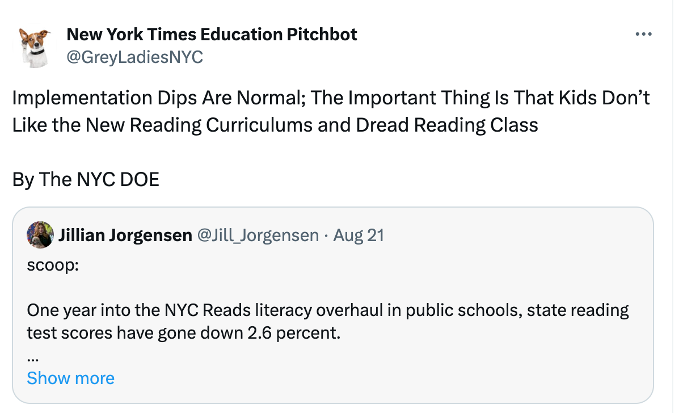
Satire…but is it really?
The “implementation dip” is the idea that performance drops when a new initiative is rolled out because, well, change is hard. Take New York City, for example. After one year of mandated Science of Reading, reading scores have dropped 2.6%. I waited a few weeks to see what the talking heads would say, but they’re being suspiciously silent while teachers slog through bloated basals and scripted lessons that promise everything except helping kids learn to love reading.
It’s supposed to get worse before it gets better, they say. But here’s the thing: sometimes, it doesn’t get better. Sometimes, it just stays bad. And instead of admitting that maybe—just maybe—the new strategy was flawed from the start, the people in charge wave their hands and say, “It’s just the implementation dip! Give it time!”
Let’s be real: what we’re actually seeing is 2.6% more disadvantage for the students who happen to be stuck in the system during this experiment. This is especially troubling for struggling readers who aren’t getting the help that could be accelerating their progress.
The Reality of Poor Implementation
The problem isn’t that teachers and administrators are resistant to change. It’s that many of these changes are half-baked from the start. When a new policy tanks, it’s often because it was built on shaky foundations—minimal training, inadequate resources, or a one-size-fits-all approach that doesn’t fit anyone.
But instead of owning up to these failures, the “implementation dip” is trotted out as the excuse du jour. It’s a way for policymakers to say, “Sure, things are a mess now, but just wait—it’ll get better eventually.” Meanwhile, teachers are left trying to make sense of a bad situation, students are left with a subpar education, and the real issues are swept under the rug.
Blame-Shifting in Action
This blame-shifting isn’t just annoying—it’s damaging. Teachers, who are doing their best with what they’ve been given, are often the ones who get blamed when things go south. They’re told they’re not implementing the new strategy correctly, or that they just need to hang in there a little longer. Meanwhile, the folks who came up with the policy in the first place are nowhere to be found.
And let’s not forget the administrators, caught in the middle, pressured to show results but without the tools to make meaningful change. The “implementation dip” becomes the go-to excuse, allowing those at the top to dodge responsibility.
The Need for Honest Accountability
If we want to see real progress in education, we need to ditch the “implementation dip” excuse and start holding policymakers accountable for their decisions. That means involving teachers in the design and rollout of new initiatives, giving them the support they need, and being honest when something isn’t working. We should be asking policymakers three important questions:
- If this implementation dip was a predictable consequence of immediate change, why were schools banned from using more successful, evidence-based programs (such as Reading Recovery) while a more thoughtful roll-out process was designed?
- How long will it take to get New York back to its previous success rate, before the more effective, well-rounded literacy approach was banned?
- Haven’t we been here before and failed? This is obviously a rhetorical question, because yes, we have, both in the US and abroad. So why can’t we agree that one-size-fits-all phonics never has the promised effect?
Not every failure is because of a so-called “dip.” Sometimes, the problem is the policy itself. No amount of grit and perseverance is going to fix a fundamentally flawed strategy.
Moving Forward
Let’s stop pretending the “implementation dip” is anything other than what it is: a way to cover your tail when things go wrong. Instead, let’s focus on giving educators the tools and freedom they need to succeed. And most importantly, let’s stop disadvantaging current students with half-baked experiments, especially when evidence-based programs are being eliminated.
Because at the end of the day, how many more students need to suffer through slipshod curriculum mandates before we admit that the pendulum might just need a little more than time to swing back? It needs a push in the right direction, and that starts with some good old-fashioned accountability.

Dr. Billy Molasso is the Executive Director of the Reading Recovery Council of North America.